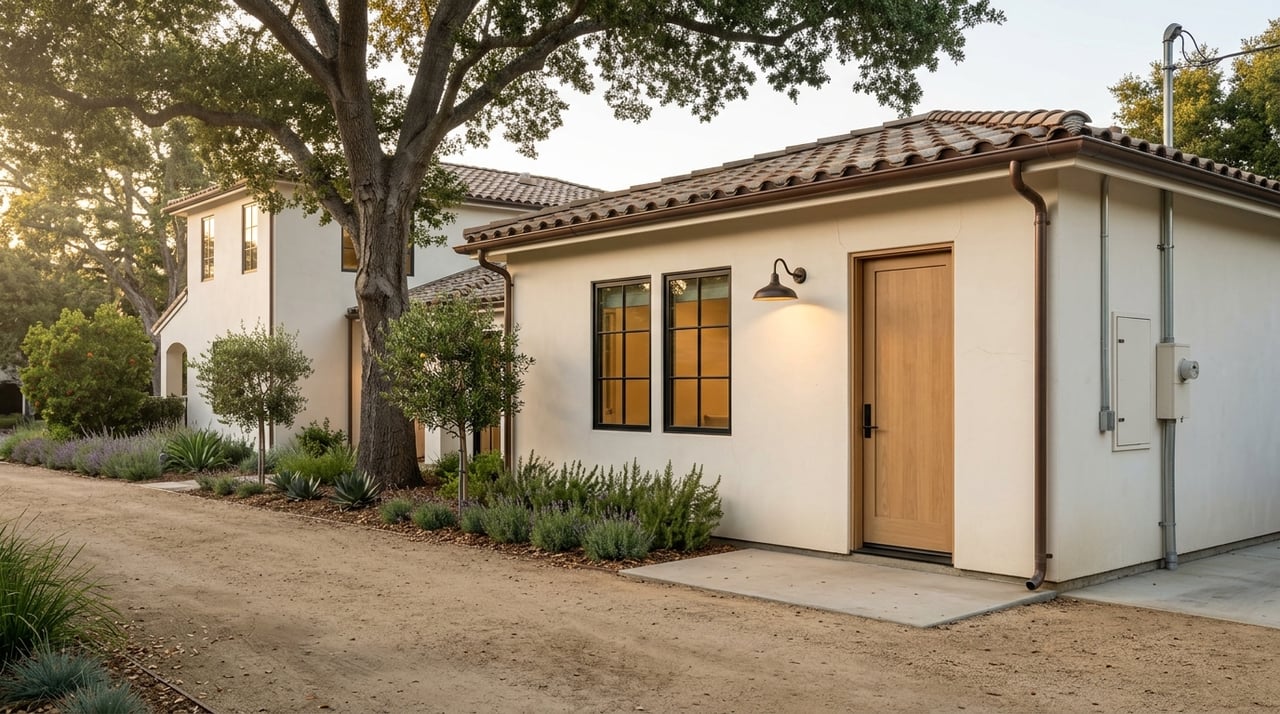
If you own a home in Calabasas, an ADU can do more than add extra space. It can create a new income stream, help offset your mortgage, and make your property more flexible for the long term. If you are weighing whether the numbers and rules make sense, this guide will walk you through the key rental income, approval, and cost factors to know before you move forward. Let’s dive in.
Why Calabasas ADUs Stand Out
Calabasas follows California’s ADU framework and allows ADUs on lots with existing or proposed single-family homes. ADUs are also allowed on duplex and multifamily lots, while JADUs are limited to single-family structures. If you want a simpler starting point, the city offers free pre-approved ADU plans in studio, one-bedroom, and two-bedroom layouts, along with a custom-plan path.
For many homeowners, that matters because the approval path can shape your timeline and upfront costs. In practical terms, Calabasas puts real emphasis on pre-reviewed plans, which can help streamline early decision-making compared with a fully custom build.
Can You Rent Out an ADU in Calabasas?
In general, yes. Under California ADU law, standard ADUs can generally be used as rentals, and local agencies cannot impose owner-occupancy requirements on standard ADUs under current state rules outlined in the California ADU handbook.
JADUs are a little different. They have tighter rules, may involve owner-occupancy requirements in certain shared-sanitation situations, and cannot be used as short-term rentals under state law. If your goal is long-term rental income with the most flexibility, a standard ADU is usually the cleaner option.
What Rental Income Could an ADU Produce?
Rental income depends on size, layout, privacy, finish level, and parking, but Calabasas rents provide a useful starting point. According to Zillow’s Calabasas rent market data, average monthly rents for smaller unit types currently sit at:
- Studio: $2,350
- One-bedroom: $2,595
- Two-bedroom: $3,300
Annualized, that works out to rough gross rent benchmarks of:
- Studio: about $28,200 per year
- One-bedroom: about $31,140 per year
- Two-bedroom: about $39,600 per year
These are planning benchmarks, not guarantees. A well-finished Calabasas ADU may land in the low-$2,000s for a studio or JADU, the mid-$2,000s for a one-bedroom, and the low-to-mid $3,000s for a two-bedroom, with privacy, parking, outdoor space, and stronger finishes pushing results higher.
How Calabasas Compares Nearby
If you are comparing Calabasas to nearby rental markets, the numbers help show why ADUs here attract attention. Nearby Agoura Hills rent data shows one-bedroom rents around $2,300 and two-bedroom rents around $3,292, while the research indicates Thousand Oaks and Oak Park trend lower overall than Calabasas.
That puts Calabasas above much of the broader Conejo market for smaller-unit rents and roughly in line with the premium Westlake Village and Agoura corridor. In plain English, the local rent environment can support thoughtful ADU planning, especially if your property offers a strong layout and privacy.
What Most Affects ADU ROI?
Many homeowners start with rent projections, but the better question is what your net income could look like after the real-world costs of building and operating the unit. In Calabasas, the biggest friction points are usually parking, fire-safety compliance, and utilities or fees.
That does not mean a project is not worth doing. It means your return is shaped as much by the details of approval and infrastructure as it is by your target rent.
Parking Rules Matter Less Than Many Owners Expect
California law limits ADU parking requirements to one space per unit or bedroom, whichever is less. Tandem parking is allowed, guest parking cannot be required, and if you convert a garage, carport, or surface parking area into an ADU, replacement parking is not required under the state ADU rules.
Parking may also be waived in several situations, including certain transit-proximate properties, conversions of existing space, and other state-defined cases. For many Calabasas owners, that can remove one of the bigger perceived barriers to adding a rental unit.
Utilities Can Affect Monthly Cash Flow
Recurring utility-related costs matter when you are estimating cash flow. In the Calabasas area, Las Virgenes Municipal Water District provides potable water and wastewater service, and its sanitation charges are based on household size.
The district’s published sanitation rates range from $27.35 per month for a one-person household to $119.37 per month for households of six or more. That means occupancy can affect your ongoing operating costs, even if your rent estimate looks strong on paper.
Fees Depend on Size and Type
Under state law, ADUs that are 750 square feet or less are exempt from impact fees. JADUs that are 500 square feet or less are also exempt, and ADUs created within existing space generally are not treated as new residential use for water and sewer connection or capacity charges unless they are built with a new single-family home, according to the California ADU handbook.
That can materially change your cost basis. If you are trying to maximize return, the unit size and whether you are converting existing space versus building new can have a major impact on the project economics.
Fire and Site Requirements Are Real
Calabasas plan-check requirements call for detailed MEP information, panel schedules and load calculations for newly built detached ADUs, and exterior work plans that show property lines and VHFHSZ notes where applicable, based on the city’s ADU plan check submittal requirements.
That is especially important because fire hazard conditions and site constraints can influence cost and design. CAL FIRE guidance through HCD makes clear that fire hazard severity zones should not by themselves block ADUs, but newly constructed units still must meet fire protection, water supply, and fire department access standards. If your main home already has sprinklers, the new ADU must have them too.
Detached ADU vs JADU for Rental Income
If your primary goal is rental flexibility, a detached or standard ADU usually offers the strongest path. It tends to provide more privacy, a more independent living setup, and clearer long-term rental use under current law.
A JADU can still be useful, especially if you want a lower-cost way to create living space inside the existing home footprint. But because JADUs have stricter rules and cannot be used as short-term rentals, they are often a more limited option from an income-planning perspective.
What If You Already Have an Older Unit?
If you have an older guest house, garage conversion, or backyard unit that was never fully permitted, it may still be possible to legalize it. State law generally says a local agency cannot deny legalization solely because an ADU or JADU built before January 1, 2020 violates building standards or local ADU rules, unless the city identifies a substandard health or safety condition, according to the HCD ADU handbook.
That can be a meaningful opportunity for homeowners sitting on unused or informal space. The key is whether the unit can satisfy health and safety review, not whether it fits every current rule exactly as if it were being built from scratch today.
A Smart Way to Evaluate Your Property
Before you count on rental income, it helps to work through a practical checklist. Focus on the issues most likely to affect timing, cost, and rent potential.
Ask yourself:
- Is your best option a detached ADU, attached ADU, conversion, or JADU?
- Would a pre-approved Calabasas plan fit your lot and goals?
- Do parking rules apply, or could your project qualify for a waiver?
- Will the site trigger added fire-access, sprinkler, or utility work?
- Is a smaller unit under key fee thresholds a better ROI move?
- Are you estimating gross rent only, or true cash flow after recurring costs?
The right answer is not always the biggest unit. In many cases, the most efficient ADU is the one that balances build cost, approval complexity, and stable rent demand.
Final Thoughts on ADU Income in Calabasas
Using an ADU for rental income in Calabasas can make sense if you approach it like an investment decision, not just a construction project. Local rent benchmarks are strong enough to get your attention, but your real return will depend on unit type, size, fee exposure, parking treatment, utilities, and fire-safety requirements.
If you are thinking about buying, selling, or repositioning a property with ADU potential in Calabasas or the surrounding Conejo market, Neeley Properties can help you evaluate how the property fits your goals and what details may matter most before you make a move.
FAQs
Can a standard ADU in Calabasas be rented for long-term income?
- Yes. Standard ADUs can generally be rented, and state law does not allow local owner-occupancy requirements for standard ADUs under current rules.
Can a JADU in Calabasas be used as a short-term rental?
- No. Under state law, JADUs cannot be used as short-term rentals.
What rent could a one-bedroom ADU in Calabasas command?
- Based on Zillow market data cited in the research, a one-bedroom in Calabasas averages about $2,595 per month, which is a useful planning benchmark but not a guarantee.
Do Calabasas ADUs always need new parking spaces?
- No. State law limits parking requirements, allows tandem parking, and waives parking in several common ADU situations, including many conversions.
Are ADUs under 750 square feet in Calabasas exempt from impact fees?
- Yes. State law says ADUs of 750 square feet or less are exempt from impact fees.
Can an older unpermitted Calabasas ADU be legalized?
- Often, yes. If the unit was built before January 1, 2020, state law generally limits denial unless the city finds a substandard health or safety condition.